Major Review Finds the Most Effective Ways to Improve VO₂max in Soccer Players
If you ask ten soccer coaches how to build endurance, you’ll probably hear ten different answers.
Some swear by repeated sprint training. Others build their preseason around small-sided games. Many still rely on traditional interval running.
A new systematic review and network meta-analysis helps answer one of the biggest conditioning questions in soccer: Which training methods actually produce the greatest improvements in VO₂max? Researchers analyzed 29 studies involving 761 male soccer players and compared multiple conditioning strategies head-to-head using network meta-analysis—a statistical approach that allows researchers to compare interventions even when they haven’t been directly tested against one another.
The results suggest that while several approaches work, high-intensity interval training (HIIT) remains the strongest overall option for improving aerobic fitness.
Why VO₂max Matters in Soccer
Soccer isn’t a continuous endurance sport, nor is it purely sprint-based.
Players repeatedly transition between jogging, sprinting, accelerating, decelerating, pressing, recovering, and changing direction over 90 minutes or more. Elite players often cover 8–13 kilometers per match while performing hundreds of high-intensity actions. Maintaining that workload requires an exceptional aerobic engine.
VO₂max—the maximum amount of oxygen the body can utilize during exercise—is one of the best indicators of aerobic fitness. Players with higher VO₂max generally:
- Recover faster between sprints
- Sustain higher work rates throughout a match
- Tolerate greater training loads
- Maintain technical performance later into games
Improving aerobic capacity has therefore become a major objective for coaches at every competitive level.
What the Researchers Did
The investigators searched four major scientific databases and identified 29 controlled studies involving healthy male soccer players.
Every study compared an additional conditioning intervention layered on top of normal soccer training. The researchers grouped the interventions into seven categories:
- High-intensity interval training (HIIT)
- Small-sided games (SSGs)
- Sprint training with change of direction (CODT)
- Strength and power training
- Inspiratory muscle training
- HIIT-based combined training
- Regular soccer training alone (control)
Using network meta-analysis allowed the authors to estimate the relative effectiveness of each approach while accounting for both direct and indirect comparisons.
The Big Winner: HIIT
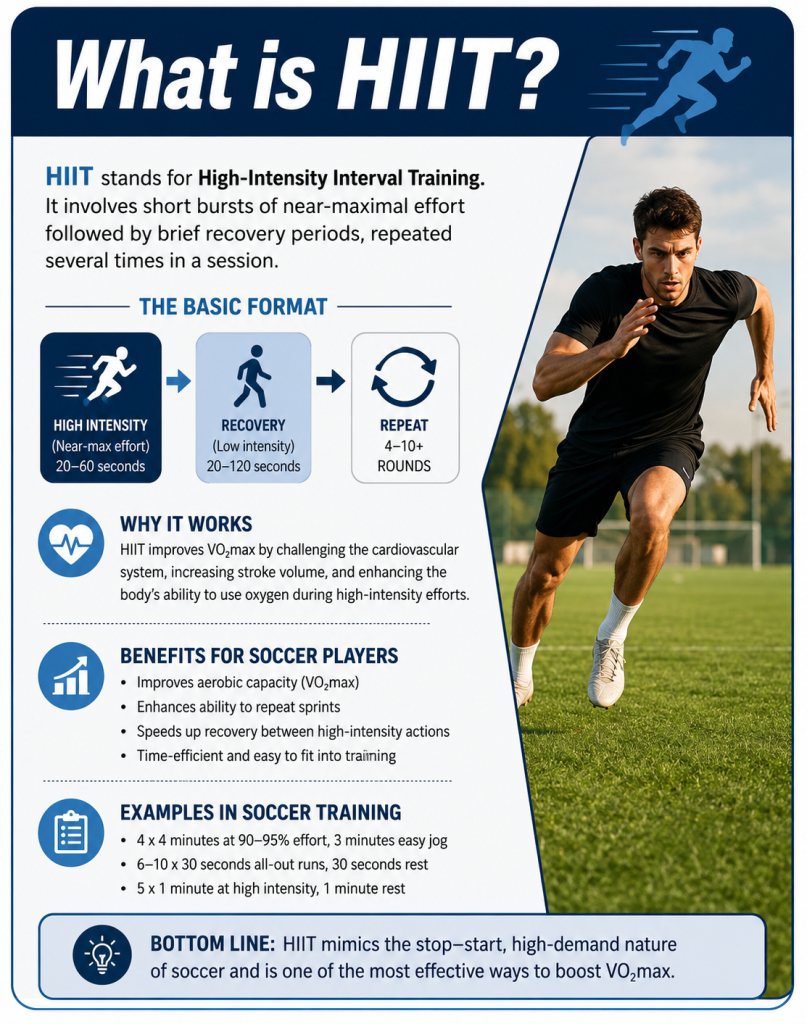
Among all training methods evaluated, HIIT ranked highest for improving VO₂max. Compared with normal soccer training:
- HIIT: Strongest overall improvement (P-score 0.85)
- Small-sided games: Second-best performer (P-score 0.77)
- Sprint training with change of direction: Third (P-score 0.60)
Importantly, HIIT consistently showed favorable effects across multiple analyses, even after removing lower-quality studies.
Small-Sided Games Are More Than Skill Work
One of the more encouraging findings for coaches is that small-sided games nearly matched HIIT. That’s significant because SSGs simultaneously develop:
- Tactical awareness
- Decision-making
- Technical skills
- Match-specific movement patterns
- Aerobic conditioning
Rather than separating fitness from soccer, well-designed small-sided games allow players to train both simultaneously.
The review suggests that coaches may not need to choose between conditioning and soccer-specific practice—properly designed SSGs can accomplish both.
Training Should Be Individualized
Perhaps the most interesting finding came from the subgroup analyses.
The “best” intervention changed depending on the player.
Younger players (<18)
Inspiratory muscle training produced the highest ranking, although the confidence intervals were wide and the evidence remains uncertain.
Adult players
Small-sided games ranked highest, followed closely by HIIT.
Lower-level players
Small-sided games again performed best.
Higher-level players
Surprisingly, strength and power training ranked first, suggesting that elite athletes may gain additional aerobic benefits through improved movement economy and neuromuscular efficiency rather than through traditional endurance work alone.
Why HIIT Probably Works So Well
HIIT closely mirrors the demands of soccer itself. Most protocols involve repeated bouts of near-maximal effort separated by short recovery periods—essentially recreating the rhythm of a competitive match. Previous research has shown HIIT improves:
- Stroke volume
- Cardiac output
- Mitochondrial density
- Capillary growth
- Oxygen extraction by working muscles
These adaptations help players repeatedly perform high-intensity efforts while recovering more efficiently between them.
A Few Important Caveats
Despite the encouraging findings, the authors caution against declaring HIIT the universal winner. Several limitations remain:
- Overall certainty of evidence was rated as low
- Training protocols varied considerably between studies
- Most comparisons involved relatively small sample sizes
- Only male soccer players were included
- The review focused specifically on VO₂max rather than overall soccer performance
In other words, HIIT appears to be the strongest current option for improving aerobic capacity—but that doesn’t necessarily make it the best choice for every player, every team, or every phase of the season.
What This Means for Coaches
The findings reinforce several practical lessons.
If your primary goal is maximizing aerobic capacity:
- HIIT remains one of the safest evidence-based choices.
- Small-sided games provide nearly equivalent conditioning while simultaneously improving soccer-specific skills.
- Change-of-direction sprint training offers another effective option, particularly when integrated into speed development.
- Elite players may benefit from greater emphasis on strength and power development alongside traditional conditioning.
- One-size-fits-all conditioning programs are unlikely to maximize results across different age groups and competitive levels.
The biggest takeaway isn’t that every coach should immediately replace their conditioning program with HIIT. Instead, this review highlights that effective conditioning should match both the physiological demands of soccer and the developmental needs of the individual player.
Key Takeaways
- HIIT ranked as the most effective training method for improving VO₂max.
- Small-sided games were a close second and offer additional tactical and technical benefits.
- Sprint training with change of direction also significantly improved aerobic fitness.
- The optimal approach may vary depending on age and competitive level.
- Coaches should individualize conditioning rather than relying on a single training model.