Can Coaches Use GPS Data to Predict How Hard Training Feels?
Youth soccer coaches have a familiar problem: two players can finish the same training session, run similar drills, and still feel completely different afterward. One player says the session was “fine.” Another says their legs are cooked. A third feels out of breath, even if their total running distance was not especially high.
A new study in Scientific Reports offers a useful way to think about that problem. The researchers studied elite youth soccer players and asked whether GPS training data could help predict not just how hard a session felt overall, but what kind of hard it felt like: muscular, respiratory, or technical-cognitive. Their answer was yes, with an important caveat: coaches need to stop treating “effort” as one single thing.
The Big Question: What Makes Soccer Training Feel Hard?
Most soccer clubs that use GPS tracking look at external load. That includes factors such as total distance, high-speed running, accelerations, decelerations, and impacts. These numbers tell coaches what a player did.
But they do not always tell coaches how the player experienced the session.
That is where perceived exertion comes in. Many coaches already use RPE, or rating of perceived exertion, where players rate how hard the session felt on a 1–10 scale. This study went a step further by using differentiated RPE, or dRPE. Instead of asking only, “How hard was training?” the researchers separated effort into several categories:
- Overall effort
- Breathlessness
- Leg muscle effort
- Technical and cognitive demand
That last one is especially interesting for soccer. A session can feel hard not just because players are running, but because they are constantly scanning, reacting, solving tactical problems, making decisions, and executing skills under pressure.
What the Researchers Did
The study followed 15 elite youth soccer players from leading academies in Poland. The players were about 14 years old and were classified as highly trained, national-level youth athletes. Goalkeepers were excluded because their movement demands are very different from field players.
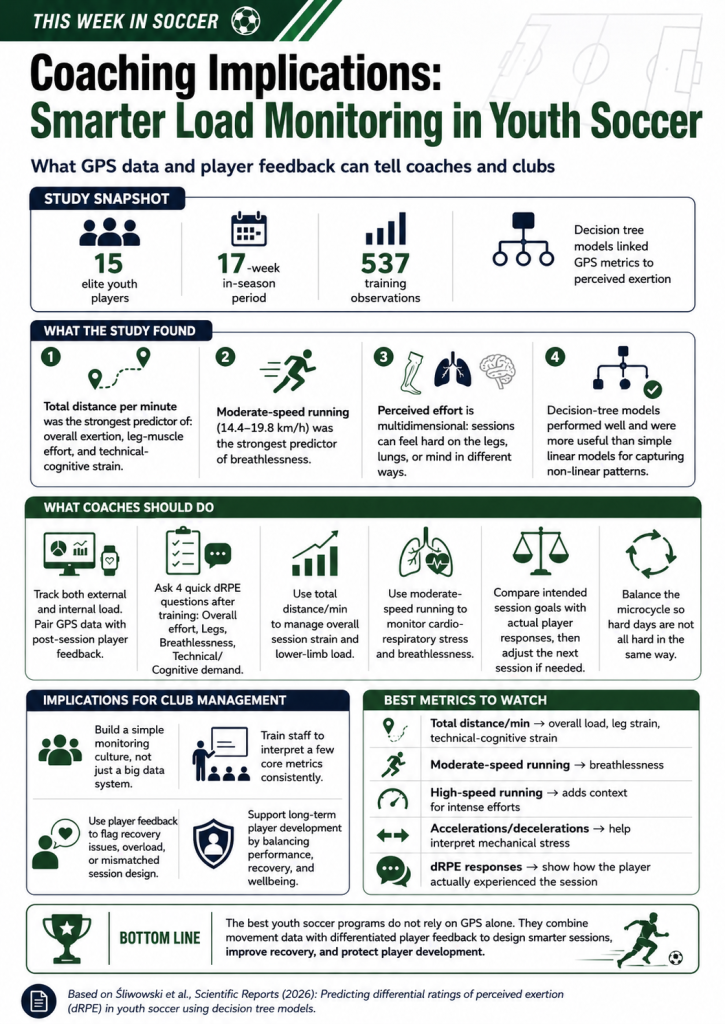
The researchers collected data across a 17-week in-season period. In total, they analyzed 537 training observations. Each training session included GPS-derived external load data and post-session perceived exertion ratings.
The GPS variables included total distance, moderate-speed running, high-speed running, accelerations, decelerations, distance covered while accelerating or decelerating, and impacts. These were normalized per minute, which matters because it lets coaches compare training intensity across sessions of different lengths.
About 20 minutes after training, players rated the session using a modified Borg CR-10 scale. They rated overall exertion, breathlessness, lower-limb effort, and technical-cognitive demand.
Then the researchers used decision tree models to see which GPS measures best predicted each type of perceived exertion.
The Main Finding: Total Distance Still Matters
The clearest result was that total distance per minute was the strongest predictor of overall exertion. It was also the strongest predictor of lower-limb effort and technical-cognitive strain.
That may sound obvious, but it is useful. In youth soccer, coaches often focus on flashy metrics like sprint distance, accelerations, or high-speed running. Those are important, but this study suggests that the basic question of how much ground a player covers per minute remains central to how hard training feels.
For coaches, that means total distance should not be dismissed as a simple or outdated metric. It may be one of the most practical indicators for managing the overall intensity of training.
The study found that total distance was the strongest predictor for:
- Overall RPE
- Lower-limb RPE
- Technical-cognitive RPE
That last point deserves attention. Higher running volume may increase not only physical strain but also the mental demands of performing soccer actions while fatigued. A possession drill, transition game, or tactical exercise may feel cognitively harder when the running load is high.
Breathlessness Was Different
Breathlessness was not best predicted by total distance. Instead, the strongest predictor of perceived breathlessness was moderate-speed running.
In this study, moderate-speed running was defined as running between 14.4 and 19.8 km/h. That is not all-out sprinting, but it is fast enough to create a real cardiovascular demand, especially when repeated in soccer’s stop-start rhythm.
This is an important coaching insight. Players may not need huge sprint numbers to feel out of breath. A session with repeated moderate-speed running, pressing, recovery runs, and transition moments can create a strong respiratory load.
That matters for session design. A coach might look at high-speed running and think, “We did not sprint much today, so the session was not that demanding.” But the players may still report high breathlessness because the session included repeated moderate-speed efforts.
Why Decision Trees Are Useful for Coaches
The researchers used decision tree models, which are a type of interpretable machine learning. Unlike black-box models, decision trees are easy to visualize. They split the data into practical thresholds. For example, if total distance per minute is above a certain level, predicted exertion goes up. If moderate-speed running crosses a threshold, breathlessness increases.
That makes this approach useful for coaches and performance staff. A decision tree can help answer practical questions like:
- When does a session become likely to feel very hard?
- Which external load metric is driving that response?
- Is the player’s strain more muscular, respiratory, or cognitive?
- Are we overloading one domain without realizing it?
The models were not perfect, and the authors are careful to note that these are predictive associations, not proof of cause and effect. But the models performed reasonably well for session-level monitoring within the squad.
What This Means for Coaching
The biggest takeaway is simple: coaches should ask better questions after training. Instead of only asking, “How hard was that?” coaches can ask:
- How hard was it overall?
- How hard was it on your legs?
- How out of breath did you feel?
- How mentally or technically demanding was it?
Those questions give coaches a more useful picture of training stress.
A session with lots of total distance may create high overall and leg exertion. A session of repeated moderate-speed running may cause severe breathlessness. A tactical session with high movement volume may create more technical-cognitive fatigue than expected.
This can help coaches better balance the week. Not every hard session is hard in the same way. A team might tolerate a physically demanding day if the next day is lighter cognitively. Or a coach might follow a tactically demanding session with a lower-complexity technical session, even if the physical load is moderate.
Implications for Youth Soccer Coaches
For youth coaches, the study supports a more individualized approach to training load. Young players are still developing physically, emotionally, and cognitively. Their responses to training can vary widely. A few practical implications stand out.
First, use RPE consistently. The best monitoring system is the one players and coaches actually use. A simple 1–10 rating after each session can be powerful, especially when collected privately and consistently.
Second, separate the type of effort. A player who reports high leg fatigue may need a different recovery strategy than a player who reports high breathlessness or mental fatigue.
Third, do not rely only on sprint data. High-speed running matters, but moderate-speed running may be more important for understanding breathlessness.
Fourth, watch total distance per minute. It may be one of the most useful “big picture” indicators of how hard the session feels.
Finally, remember that youth players are not small adults. Their training responses may be shaped by growth, maturation, confidence, playing role, and experience. Coaches should use data to guide conversations, not replace them.
Implications for Club Management
For club directors and technical leaders, this study has broader implications. Many clubs invest in GPS systems but do not always have a clear plan for turning data into better coaching decisions.
This research suggests that clubs should focus less on collecting every possible metric and more on building a simple monitoring culture.
That means creating a shared system where coaches, performance staff, and players understand what is being tracked and why. A club does not need to overwhelm youth coaches with dashboards. Instead, it can identify a few core indicators:
- Total distance per minute
- Moderate-speed running per minute
- High-speed running
- Accelerations and decelerations
- Differentiated RPE ratings
From there, clubs can develop age-appropriate training benchmarks. Over time, they can learn what different session types usually feel like for different teams and age groups.
This can also support player welfare. If a player’s perceived effort is unusually high compared with their GPS load, that may be a signal to check in. Maybe they are tired, stressed, sick, under-recovered, or struggling with confidence. Data does not diagnose the problem, but it can raise the right question.
For academy environments, this is especially valuable. Player development is not only about pushing harder. It is about knowing when to push, when to recover, and how to build long-term capacity without burning players out.
A Practical Model for Clubs
A simple club workflow could look like this:
After each session, players complete four quick ratings: overall effort, legs, breathlessness, and technical-cognitive demand.
Performance staff review the ratings alongside GPS metrics, especially total distance per minute and moderate-speed running.
Coaches compare the intended session goal with the actual load response.
If a session was meant to be tactical but produced high leg fatigue, the design may need adjusting.
If a session was meant to build aerobic demand but players reported low breathlessness, the intensity may not have matched the goal.
If players repeatedly report high cognitive load, coaches may need to simplify instructions, reduce decision density, or adjust the weekly rhythm.
The point is not to make youth soccer robotic. The point is to help coaches see what is happening more clearly.
The Caution: This Study Has Limits
This was a small study involving 15 players from a single academy context. The players were elite male youth field players, so the findings may not apply directly to girls’ teams, recreational players, older athletes, or other club environments.
The authors also note that the data involved repeated observations within players. That is realistic for team monitoring, but it can make prediction models look more stable than they would be in a new setting. The study also did not include contextual factors like position, maturation status, tactical role, or match exposure.
So clubs should not copy the exact thresholds from the study and treat them as universal rules. Instead, they should use the logic: combine external load data with differentiated player feedback, then build team-specific patterns over time.
The Bottom Line
This study offers coaches and club leaders a better way to approach training load. Soccer effort is not one-dimensional. A session can be hard on the legs, hard on the lungs, hard on the brain, or all three at once.
For coaches, the message is clear: ask players more specific questions about how training felt. For clubs, the message is just as important: GPS data becomes more valuable when it is connected to the player’s own experience.
Total distance may tell you a lot about overall strain. Moderate-speed running may tell you more about breathlessness. But the player’s perception still matters.
The best clubs will not be the ones with the most data. They will be the ones that use data to make better decisions, protect young athletes, and design smarter training.