FIFA World Cup 2026 Predictions: A Shock Champion, a Japanese Cinderella Run, and the End of Football’s Biggest Curse
Every World Cup begins with the same question:
Who is going to win it all?
Bookmakers currently favor Spain, France, England, Argentina, and Brazil. Most pundits are gravitating toward the usual suspects. But one of the most interesting forecasting models published ahead of the tournament sees the bracket unfolding very differently.
According to a quantitative model developed by economist Joachim Klement—one that correctly forecast Germany in 2014, France in 2018, and Argentina in 2022—the 2026 FIFA World Cup could produce one of the most surprising champions in modern football history.
The model’s prediction?
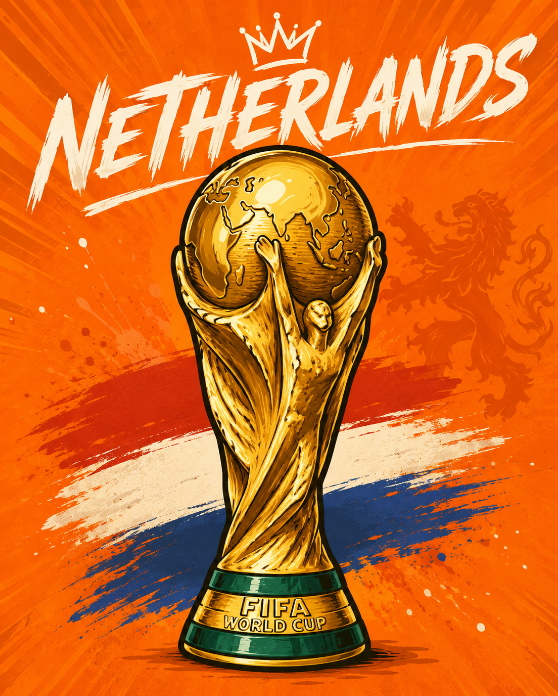
The Netherlands will win the 2026 FIFA World Cup.
And that’s not even the most surprising part.
The Biggest Story: The Netherlands Finally Break Through
Few countries have suffered more World Cup heartbreak than the Netherlands.
The Dutch reached the finals in 1974, 1978, and 2010 but lost all three. Despite producing legends such as Johan Cruyff, Marco van Basten, Dennis Bergkamp, Wesley Sneijder, and Arjen Robben, the Oranje have never lifted football’s biggest trophy.
This model predicts that the drought will finally end.
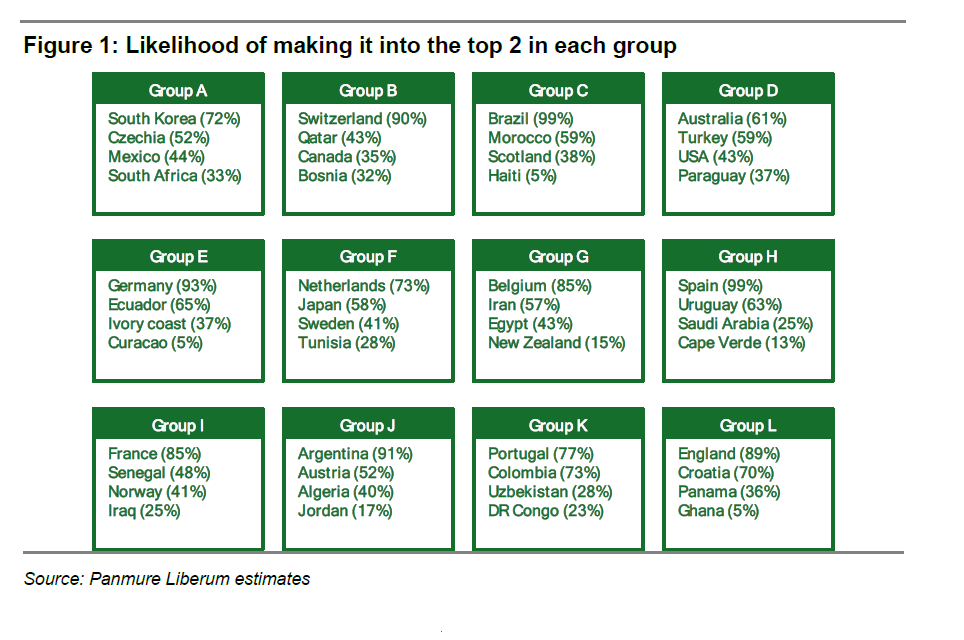
The forecasted path is anything but easy. The Netherlands are projected to survive a difficult group featuring Japan and Sweden, then grind through Morocco, France, Spain, and Portugal on the way to the title. Rather than dominating opponents, the Dutch advance through a series of narrow, low-scoring victories—the type of tournament run often associated with eventual champions.
For Dutch supporters, it would be the culmination of more than fifty years of near misses.
Japan: The Tournament’s Most Dangerous Dark Horse
Every World Cup features a breakout team.
In 2022, it was Morocco. In 2018, it was Croatia.
For 2026, this model identifies Japan.
The forecast predicts Japan advancing from a difficult group with the Netherlands before producing what would rank as one of the biggest upsets in World Cup history: eliminating Brazil in the Round of 32.
That prediction may sound outrageous at first glance.
Yet Japan has steadily transformed from a respected Asian power into a legitimate global contender. The model points to recent results against elite competition and Japan’s increasingly deep player pool across Europe’s top leagues as evidence that the gap between Japan and traditional powers has narrowed dramatically.
The projected run ends in the quarterfinals against England, but by then Japan would have become the story of the tournament.
Why Spain and France Remain the Teams to Beat
Even though neither side wins the tournament in this forecast, Spain and France remain the strongest teams on paper.
Spain enters the competition as perhaps the world’s most complete squad. With Lamine Yamal emerging as one of football’s brightest stars and a midfield overflowing with elite talent, Spain is projected to reach the semifinals before falling to the Netherlands in a penalty shootout.
France is equally impressive.
Kylian Mbappé remains the centerpiece, but France’s strength comes from its depth. The model repeatedly highlights the quality throughout the French roster and views Les Bleus as one of the world’s two strongest teams entering the tournament. Yet even elite teams can fall victim to knockout-stage randomness. In this scenario, France reaches the quarterfinals before being upset by the Netherlands.
What About Argentina and Brazil?
The model takes a surprisingly cautious stance toward both South American giants.
Argentina is projected to win its group and make a deep run but eventually fall to Portugal in the quarterfinals. While the reigning champions remain dangerous, the forecast argues that the current squad is not as strong as the team that triumphed in Qatar four years ago.
Brazil receives an even harsher assessment.
The Seleção are forecast to win their group comfortably but suffer a shocking knockout-stage defeat to Japan. If it happens, it would instantly become one of the defining moments of the tournament.
The Surprise Final: Netherlands vs. Portugal
Perhaps the boldest prediction is the championship match itself.
Rather than a final featuring Spain, France, Brazil, Argentina, or England, the model projects:
Netherlands vs. Portugal
Neither nation has ever won a World Cup. Portugal’s only major international trophy remains Euro 2016, while the Netherlands continue to carry the burden of being football’s greatest nearly-team.
In a tournament defined by parity, expanded knockout rounds, and the growing quality of nations outside the traditional elite, the model sees an opening for a first-time champion.
The Dutch seize it.
How the Forecast Was Built
Unlike many soccer prediction systems that rely exclusively on team ratings or betting markets, this model combines several factors:
- FIFA ranking strength
- GDP per capita
- Population size
- Climate conditions
- Host-country advantage
- A random component to reflect football’s inherent unpredictability
The underlying theory is that successful national teams emerge not only from talented players but also from broader social and developmental conditions that support long-term soccer success. The model explains approximately 55% of variation in World Cup performance, with the remaining 45% attributed to luck and uncertainty.
Important Limitations
Before anyone starts placing bets, several caveats matter.
First, the 2026 World Cup introduces a new 48-team format and an expanded knockout stage. More knockout games generally increase the role of randomness because a single poor performance can eliminate even elite teams.
Second, injuries, suspensions, tactical decisions, and individual moments of brilliance remain impossible to predict. A single red card or penalty shootout can completely alter the tournament.
Third, even the model’s creator repeatedly emphasizes that these forecasts should be viewed as probabilities rather than certainties. A team with a 70% chance of advancing still fails 30% of the time.
In other words, this forecast is best viewed as a fascinating scenario—not destiny.
Our Take
If this prediction proves correct, World Cup 2026 will be remembered for three things:
- Japan’s emergence as a genuine global power.
- The expanded tournament creating unprecedented chaos.
- The Netherlands finally winning the trophy that has eluded them for generations.
Will it happen? Probably not exactly this way. But after correctly identifying the last three World Cup champions, this forecast deserves attention.
And if you’re looking for one team to watch beyond the usual favorites, keep an eye on Japan.
The model thinks they might change the tournament.