Sharks and Minnows: The Classic Youth Soccer Game Every Coach Should Have in Their Toolbox
Some soccer games survive because they are simple, fun, and secretly full of learning. Sharks and Minnows is one of those games.
If you coach young players, especially ages 4 to 10, this game can become one of your go-to activities. It gets kids moving right away. It creates laughter. It builds comfort with the ball. It teaches players to dribble under pressure without making practice feel like a lecture.
At its heart, Sharks and Minnows is a dribbling game. Players try to move from one side of the field to the other while avoiding defenders. The defenders, called sharks, try to steal or kick away the ball. The players with the ball, called minnows, try to escape.
That is the basic idea. The magic is in how you coach it.
Used well, Sharks and Minnows can teach dribbling, shielding, changes of direction, ball control, speed changes, spatial awareness, bravery, creativity, and decision-making. It can also help young players learn how to handle pressure in a fun, low-stakes way.
This guide breaks down how to play Sharks and Minnows, what skills it develops, how to coach it, and how to change the game to focus on different soccer skills.
What Is Sharks and Minnows in Soccer?
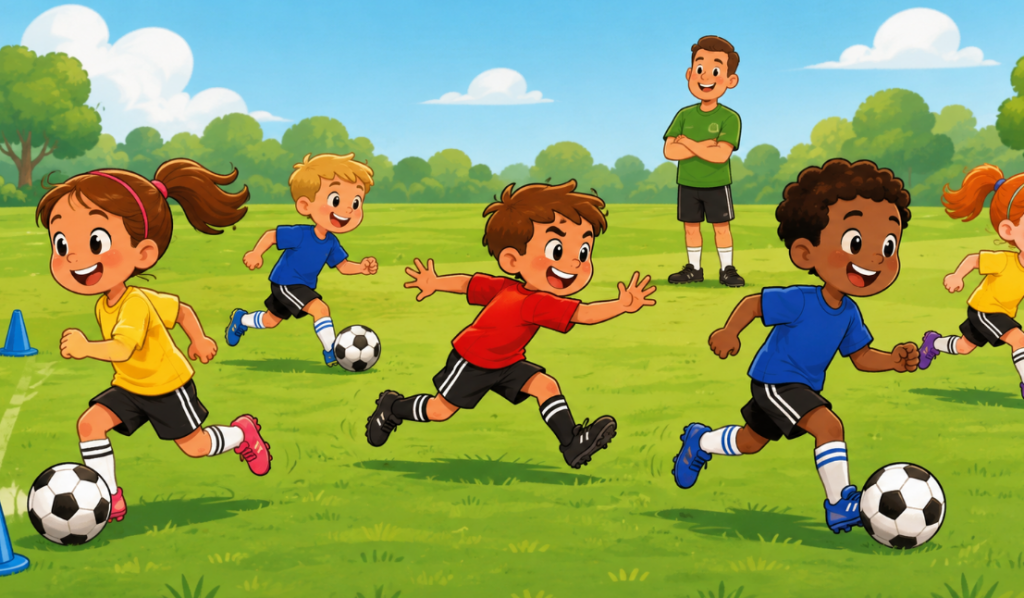
Sharks and Minnows is a youth soccer dribbling game where most players begin as minnows with a ball. One or more players start as sharks. The minnows try to dribble across a marked space without losing their ball. The sharks try to steal, kick away, or tag the minnows’ balls.
The game is popular because it is easy to explain and easy to run. You can play it with a full team, a small group, or even just a handful of players.
It works especially well for young players because it feels like a playground game. Kids understand the idea right away. Sharks chase. Minnows escape. Everyone moves.
For coaches, that means less time explaining and more time playing.
Why Coaches Love Sharks and Minnows
Sharks and Minnows checks a lot of boxes for a youth soccer practice.
It is active. It keeps most players moving most of the time.
It is fun. The theme is easy for kids to understand.
It is flexible. You can make it easier, harder, faster, slower, silly, competitive, or more technical.
It teaches real soccer skills. Players have to dribble with their head up, change direction, protect the ball, and find open space.
It also gives coaches a chance to observe. You will quickly see which players keep the ball close, which players kick it too far ahead, which players panic under pressure, and which players naturally look for open space.
That makes Sharks and Minnows more than just a warm-up game. It is a coaching tool.
How to Set Up Sharks and Minnows
You do not need much equipment. You need:
- Cones
- Soccer balls
- A playing area
- Players
Set up a rectangular grid. The size depends on the age and skill level of your players.
For younger players, start with a smaller space, such as 15 by 20 yards. For older or more skilled players, use a larger space, such as 20 by 30 yards or 25 by 35 yards.
Every minnow needs a ball. The shark does not need a ball.
Choose one or two players to begin as sharks. Everyone else starts as a minnow on one end line with a ball.
The sharks stand in the middle of the grid.
When the coach says “Go,” the minnows dribble from one end of the grid to the other. The sharks try to steal or kick their soccer balls out of the grid.
If a minnow makes it safely to the other side, they wait for the next round.
If a shark kicks a minnow’s ball out, that player becomes a shark in the next round.
Keep playing until only one or two minnows remain.
Then restart with new sharks.
Basic Rules for Sharks and Minnows
Here is a simple version you can use with most youth teams.
- Every minnow starts with a ball.
- Sharks start in the middle without a ball.
- Minnows must dribble from one end line to the other.
- Sharks try to kick the minnows’ balls out of the grid.
- If your ball goes out, you become a shark.
- If you make it across safely, you stay a minnow.
- The last minnow left wins the round.
Keep the rules simple at first. Young players do better when they can start quickly and learn by playing.
You can add more details once they understand the game.
What Skills Does Sharks and Minnows Teach?
Sharks and Minnows looks like a chase game, yet it develops many important soccer skills.
Dribbling Under Pressure
This is the biggest skill. In soccer, players rarely dribble in a straight line with no pressure. They have to dribble while defenders close space, reach for the ball, and force them to make quick choices.
Sharks and Minnows creates that pressure in a playful way. Players learn that they cannot just kick the ball and run. They have to control it. They have to keep it close enough to change direction. They have to decide when to speed up and when to slow down.
Ball Control
Young players often push the ball too far ahead. Sharks and Minnows gives them a reason to keep the ball close. If the ball gets too far away, a shark can steal it.
That lesson lands better during the game than it does during a long explanation. The game teaches the skill through experience.
Changing Direction
A good minnow does not run straight into the shark. They move away from pressure. They turn. They cut. They dodge. That means players naturally practice inside cuts, outside cuts, pullbacks, stepovers, and quick turns.
For younger players, do not worry if the moves look messy. The goal is comfort and creativity. Clean technique comes with repetition.
Shielding the Ball
When a shark gets close, players need to put their body between the defender and the ball. That is shielding. Many young players do this naturally once they feel pressure. Coaches can help by giving one simple cue:
“Put your body between the shark and your ball.”
That cue is easy to understand and easy to see.
Head-Up Dribbling
Players who stare only at the ball usually run into sharks. Players who look up can spot open space.
Sharks and Minnows gives players a reason to lift their head while dribbling. They need to see the shark, the sideline, the end line, and the gaps. A great coaching cue is:
“Can you see the shark and the ball?”
That tells players they need both control and awareness.
Speed Changes
The best dribblers change speed. They might move slowly to draw in a shark, then burst into open space. They might pause, cut, and accelerate. They might sprint when a lane opens.
Sharks and Minnows helps players feel when to go slow and when to explode.
Decision-Making
Young players need lots of chances to make soccer decisions. In Sharks and Minnows, players constantly ask themselves:
- Where is the shark?
- Where is open space?
- Should I go now?
- Should I wait?
- Should I turn?
- Should I protect the ball?
- Should I sprint?
That is real decision-making. The coach does not have to stop the game every few seconds to explain. The game creates the problem. The players solve it.
Confidence
Some players are nervous with the ball. They get scared when defenders come near them. Sharks and Minnows helps players face pressure in a fun way. They get many chances to try again. They learn that losing the ball is part of the game.
For young kids, this matters a lot. A confident dribbler is willing to try things. That willingness is one of the foundations of long-term development.
How to Coach Sharks and Minnows
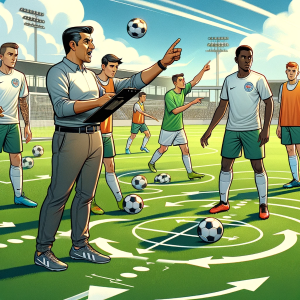
The best way to coach Sharks and Minnows is to keep the game moving. Avoid long speeches. Young players need action. Use short coaching points between rounds. Good coaching cues include:
- “Keep the ball close.”
- “Look for open space.”
- “Use little touches near the shark.”
- “Big touch into space.”
- “Change speed.”
- “Change direction.”
- “Put your body between the shark and the ball.”
- “Can you trick the shark?”
- “Can you escape into space?”
Pick one coaching point at a time. Let them play. Watch what happens. Then add another cue. If you give young players five things to think about, they may remember none of them. Give them one thing and they can actually use it.
Common Coaching Mistakes
Sharks and Minnows is simple, which is part of why it works. Some coaches accidentally make it less effective by overcomplicating it.
Mistake 1: The Field Is Too Big
If the field is too big, minnows can run around without needing much skill. They can kick the ball forward and chase it. A smaller field creates more pressure and more touches. For younger players, start smaller. Make the space bigger if the sharks are winning too quickly.
Mistake 2: The Field Is Too Small
If the field is too small, players may crash into each other. The game can become chaotic in a way that does not help learning. You want pressure, space, and movement. If players cannot dribble for more than a second before being tackled, expand the grid.
Mistake 3: Too Many Sharks at the Start
One shark is usually enough for a small group. Two sharks can work for larger groups. If you start with too many sharks, the first round may end too quickly. Let the game build. As more minnows are caught, the pressure naturally increases.
Mistake 4: Long Lines
Sharks and Minnows works best when everyone is involved. Avoid versions where most players stand and wait. Keep all minnows active. If players get knocked out, make them sharks so they keep playing.
Mistake 5: Too Much Talking
This game should feel fast, fun, and alive. Coach briefly. Play often.
Sharks and Minnows Variations by Skill Focus
The best part of Sharks and Minnows is how easy it is to adjust. A small rule change can shift the skill focus. Here are several variations you can use depending on what you want to teach.
Variation 1: Classic Dribbling Sharks and Minnows
Best for: Ball control, dribbling under pressure, awareness
This is the standard version. Minnows dribble across the grid. Sharks try to kick the balls out. Players who lose their ball become sharks. This version is great for young players because it teaches the game’s basic rhythm. Coaching focus:
- Keep the ball close near pressure.
- Look up before you move.
- Find space.
- Change direction.
- Change speed.
This should be the first version you teach.
Variation 2: Freeze Tag Sharks and Minnows
Best for: Ball control, stopping the ball, awareness, teamwork
In this version, sharks do not kick balls out. They tag a player or touch the player’s ball. When a minnow is tagged, they freeze with one foot on the ball. To unfreeze, another minnow must dribble over, give them a high-five, pass through their legs, or dribble around them. This version keeps more players in the game and adds teamwork. Coaching focus:
- Stop the ball under control.
- Look for teammates.
- Help others safely.
- Move away from pressure after rescue.
This is great for younger players who may get upset when they are “out.”
Variation 3: Shielding Sharks and Minnows
Best for: Protecting the ball, body position, and strength on the ball. In this version, sharks must try to steal the ball rather than just kick it away. The minnow can shield for a few seconds before trying to escape. You can create small “safe zones” where players are safe for three seconds. This teaches players to use their bodies, arms for balance, and a strong stance to protect the ball. Coaching focus:
- Body between defender and ball.
- Knees bent.
- Use the far foot.
- Feel the pressure.
- Turn away from the shark.
This version is especially useful for players who panic when defenders get close.
Variation 4: Weak Foot Sharks and Minnows
Best for: Developing both feet. All minnows must dribble mostly with their weaker foot. For very young players, you can say:
- “Try to use your other foot as much as you can.”
- For older players, be stricter:
- “Every touch must be with your left foot.”
- This variation helps players build comfort with both feet.
Coaching focus:
- Small touches.
- Keep balance.
- Use the inside and outside of the foot.
- Do not rush.
Expect this version to be messy. That is okay. The goal is development.
Variation 5: Move of the Round
Best for: Skill moves, creativity, confidence Before each round, teach or review one move. For example:
- Pullback
- Inside cut
- Outside cut
- Step-over
- Scissors
- Cruyff turn
- Sole roll
- Stop and go
To cross safely, each minnow must use the move at least once during the round. This gives players a reason to try new moves during live play. Coaching focus:
- Try the move before the shark gets too close.
- Sell the move with your body.
- Accelerate after the move.
- Be brave.
Do not demand perfection. Praise attempts.
Variation 6: Gates Sharks and Minnows
Best for: Dribbling with purpose, scanning, changing direction.
Set up small cone gates throughout the grid. Minnows score points by dribbling through gates while avoiding sharks. You can play for 60 seconds and ask players to count their points. If a shark steals the ball, the minnow loses one point or becomes a shark. This variation encourages players to scan the field and choose a path. Coaching focus:
- Look for open gates.
- Turn away from crowded spaces.
- Plan your next move.
- Use both feet.
This is a strong variation for players who need more direction than simply “get across.”
Variation 7: Treasure Island Sharks and Minnows
Best for: Dribbling, turning, ball control, fitness
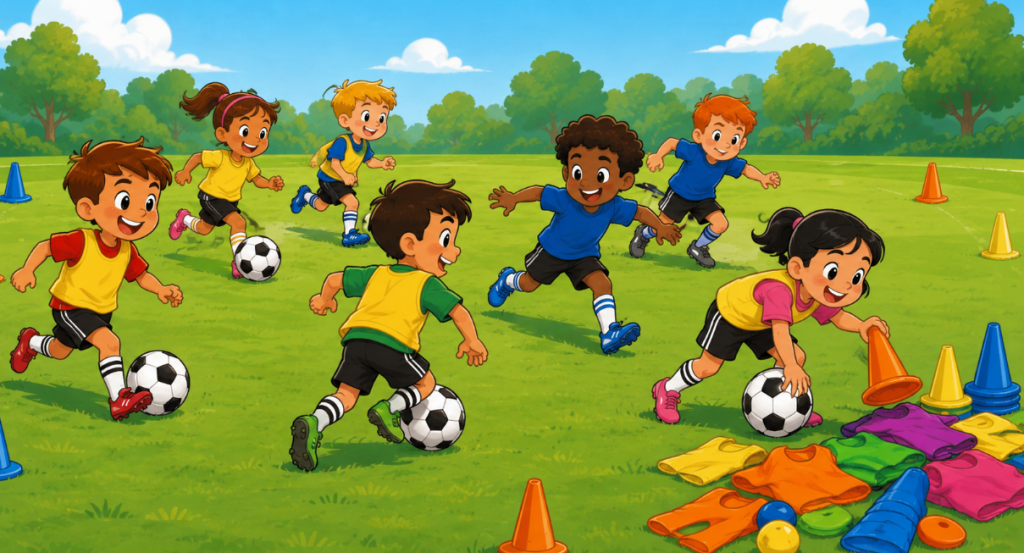
Place a pile of cones, pinnies, or small objects on one side of the field. This is the treasure. Minnows start on the other side with a ball. They must dribble across, collect one piece of treasure, and dribble back without losing their ball. Sharks try to knock balls away. This gives the game a clear mission. Coaching focus:
- Control the ball while changing tasks.
- Slow down near the treasure.
- Turn quickly.
- Escape after picking up the treasure.
Kids love this version because it feels like an adventure.
Variation 8: Team Sharks and Minnows
Best for: Teamwork, communication, group tactics
Split the players into two teams. One team starts as minnows. One team starts as sharks. Minnows try to get across. Sharks try to win the ball or force it out. Count how many minnows make it across. Then switch roles. The team with the most successful crossings wins.
Coaching focus:
- Minnows should spread out.
- Sharks should work together.
- Attack open space.
- Communicate.
- Do not all dribble into the same area.
This version works better with older players who understand team scoring.
Variation 9: Safe Island Sharks and Minnows
Best for: Decision-making, timing, awareness
Place two or three small safe zones inside the grid. These can be circles or boxes made with cones. Minnows may enter a safe zone for three seconds. After three seconds, they must leave. Only one or two players can be in a safe zone at a time. This variation teaches players to use space, time their runs, and avoid hiding. Coaching focus:
- Use safe zones as a quick break.
- Look before leaving.
- Do not wait too long.
- Explode into space.
This is helpful for nervous players because it gives them moments of success.
Variation 10: Knockout Sharks and Minnows
Best for: Defensive pressure, tackling, competitiveness
In this version, sharks try to knock the ball out of the grid. If a minnow loses the ball, they leave the grid and perform a quick task before rejoining. The task might be:
- Five toe taps
- Five foundations
- Three ball rolls
- One lap around the grid
Then they come back in as a shark or rejoin as a minnow, depending on your goal.
Coaching focus:
- Defenders close space quickly.
- Attackers protect the ball.
- Recover quickly after losing it.
Use this version carefully with younger kids. Keep the tone playful.
Variation 11: Numbers Sharks and Minnows
Best for: Listening, reaction speed, decision-making
Give each player a number. Call out certain numbers to cross. For example:
“Numbers 1 and 3, go!”
Only those players dribble across while the sharks defend. This creates smaller waves of pressure and gives players more space to succeed.
Coaching focus:
- Be ready.
- Attack quickly.
- Watch the shark.
- Find the open lane.
This is useful when the full-group version gets too crowded.
Variation 12: Coach as the Shark
Best for: Younger players, confidence, fun
The coach starts as the shark. This is one of the best versions for 4-year-olds, 5-year-olds, and newer players. Kids love trying to beat the coach. Be dramatic. Miss tackles on purpose sometimes. Let kids escape. Make the game joyful.
Coaching focus:
- Keep the ball moving.
- Run into space.
- Try to trick the coach.
This version is perfect for early-season practices when players are still getting comfortable.
Variation 13: Parent Sharks
Best for: Team fun, end-of-season practices, family events
Invite parents or older siblings to be sharks. The kids dribble as minnows. This can be hilarious and memorable. Keep the rules safe and light. Parents should move slowly and play gently.
Coaching focus:
- Confidence.
- Joy.
- Community.
- Ball control under fun pressure.
This is a great activity for a final practice or team celebration.
Variation 14: Passing Sharks and Minnows
Best for: Passing, support, teamwork
Pair players together with one ball per pair. The pair must pass the ball across the grid while avoiding sharks. If the shark steals or kicks the ball out, the pair becomes sharks. This shifts the focus from individual dribbling to passing and movement.
Coaching focus:
- Pass into space.
- Move after passing.
- Use the inside of the foot.
- Talk to your partner.
- Do not stand still.
This version works best with players who already have basic passing skills.
Variation 15: First Touch Sharks and Minnows
Best for: Receiving, first touch, body shape
Set up the game with partners. One player passes into the grid. The receiving player must take a first touch and dribble across while avoiding sharks. You can rotate roles each round.
Coaching focus:
- First touch away from pressure.
- Open body shape.
- Look before receiving.
- Touch into space.
This is better for older or more advanced players.
Variation 16: Defender Development Sharks and Minnows
Best for: Defensive footwork, patience, angle of approach
Most coaches use Sharks and Minnows for dribbling. It can also teach defending. Give sharks a specific defensive goal:
- Stay low.
- Do not dive in.
- Force the minnow toward the sideline.
- Win the ball cleanly.
- Recover after getting beaten.
This turns the shark role into a real learning opportunity.
Coaching focus:
- Close space.
- Slow down near the attacker.
- Stay balanced.
- Watch the ball.
- Win it when the touch gets too big.
This is a great way to teach defenders without setting up formal 1v1 drills.
How to Adjust Sharks and Minnows by Age
Ages 4 to 5
Keep it simple and silly. Use a small space. Have the coach start as the shark. Do short rounds. Celebrate effort. At this age, the main goals are movement, comfort with the ball, listening, and joy. Use cues like:
- “Keep your ball close.”
- “Run away from the shark.”
- “Stop your ball on the line.”
- “Can you trick me?”
Do not worry too much about perfect technique.
Ages 6 to 7
Players can handle more rules and more competition. Use one or two sharks. Let players who lose the ball become sharks. Add simple skill challenges, such as using a pullback or inside cut. At this age, focus on dribbling control, changing direction, and finding space.
Ages 8 to 10
Players can handle tactical ideas. Start adding variations that teach shielding, team play, weak foot dribbling, and defender technique. Ask questions between rounds:
- “Where was the open space?”
- “What worked when the shark got close?”
- “How did you protect the ball?”
Let players explain what they noticed.
Ages 11 and Up
Sharks and Minnows can still work for older players if you make it more soccer-specific! Use smaller spaces, timed rounds, team scoring, passing versions, first-touch versions, and defending constraints. For older players, the game should connect clearly to match situations, such as beating pressure, escaping tight spaces, or protecting the ball near the sideline.
Coaching Questions to Ask Players
Good questions help players think without turning practice into a classroom. After a round, ask one quick question:
- “What did you do when the shark got close?”
- “Where was the safest space?”
- “How did you know when to sprint?”
- “What move helped you escape?”
- “What could you try next time?”
- “Why is it helpful to keep the ball close?”
For young players, keep questions simple. For older players, let them explain more. The goal is to help players notice the game.
How Long Should You Play Sharks and Minnows?
For younger players, 8 to 12 minutes is usually enough. For older players, you can use it for 10 to 15 minutes if you add variations. A good pattern is:
- 2 minutes: explain and demo
- 3 minutes: classic version
- 2 minutes: quick coaching point
- 3 minutes: new variation
- 2 minutes: final challenge round
End while the energy is still high. If kids are asking for “one more round,” that is a good sign.
Where Sharks and Minnows Fits in a Practice Plan
Sharks and Minnows works well as:
- A warm-up
- A dribbling activity
- A transition game
- A fun conditioning game
- A confidence-building activity
- A closing game for young players
For young teams, it can be the main activity of the practice. For older teams, it can lead into 1v1 games, small-sided games, or possession activities. A simple practice flow might look like this:
- Start with free dribbling.
- Play Sharks and Minnows.
- Move into 1v1 to end zones.
- Finish with 3v3 or 4v4.
That creates a natural learning path. Players first dribble in traffic, then face direct pressure, then use those skills in a real game.
Safety Tips
Sharks and Minnows is active and exciting, so safety matters.
- Use enough space for the number of players.
- Keep balls on the ground.
- Teach players to avoid pushing, grabbing, and sliding.
- Use soft pressure with very young players.
- Make sure players stop at the end line.
- Keep extra balls away from the playing area.
If the game gets too wild, pause for a reset. You can say: “Freeze. Take a breath. Show me your ball under your foot.” Then restart.
How to Make the Game More Inclusive
Some players are fast. Some are cautious. Some are brand new. Some are still learning how to control the ball. A good coach adjusts the game so every player has a chance to learn.
You can make the game easier by:
- Making the field wider
- Starting with only one shark
- Letting players use safe zones
- Having sharks tag the ball gently
- Giving minnows a head start
- Letting caught players rejoin after a skill task
You can make the game harder by:
- Making the field narrower
- Adding more sharks
- Requiring a specific move
- Requiring weak foot touches
- Adding gates or scoring zones
- Giving players a time limit
The best version is the one that gives your players the right level of challenge.
What to Watch For as a Coach
Sharks and Minnows gives you a lot of information. Watch how players move.
- Are they keeping the ball close?
- Are they looking up?
- Are they using both feet?
- Are they changing direction?
- Are they protecting the ball?
- Are they dribbling into pressure?
- Are they finding open space?
- Are they freezing when challenged?
- Are they willing to try moves?
Use what you see to choose your next activity. If players lose the ball because they kick it too far, work on close control. If players run straight into defenders, work on changing direction. If players panic when pressured, work on shielding. If players never look up, add gates or safe zones to encourage scanning.
The game tells you what the team needs.
Sample Sharks and Minnows Session Plan
Here is a simple 20-minute block for ages 6 to 8.
Minute 0 to 3: Ball Familiarity
Each player has a ball. Ask players to dribble around the space. Use simple commands:
- Stop
- Go
- Turn
- Toe taps
- Pullback
- Fast dribble
- Slow dribble
Minute 3 to 8: Classic Sharks and Minnows
Start with one shark. Play several short rounds. Coaching cue:
“Keep the ball close when the shark is near.”
Minute 8 to 12: Move of the Round
Teach a pullback or inside cut. Players must try that move once before crossing. Coaching cue:
“Turn away from the shark, then speed up.”
Minute 12 to 16: Safe Island Version
Add two safe zones. Players can stay in a safe zone for three seconds. Coaching cue:
“Look before you leave the island.”
Minute 16 to 20: Championship Round
Play one final classic round. Praise effort, creativity, and bravery. End with a quick question:
“What helped you escape the shark?”
Why Sharks and Minnows Works So Well
The best youth soccer games teach through play. Sharks and Minnows gives players a clear problem: get across without losing the ball. That problem is simple enough for young players to understand. It is also rich enough to develop real soccer skills.
Players learn to control the ball because they need to. They learn to look up because they need to. They learn to turn, shield, and accelerate because the game rewards those choices.
That is why Sharks and Minnows has lasted so long. It is fun. It is flexible. It works.
For youth soccer coaches, especially coaches of young or beginner players, Sharks and Minnows is one of the easiest ways to turn practice into a learning environment that feels like play. And when kids are laughing, moving, touching the ball, and solving soccer problems, you are doing something right.