Stronger Knees, Safer Cuts
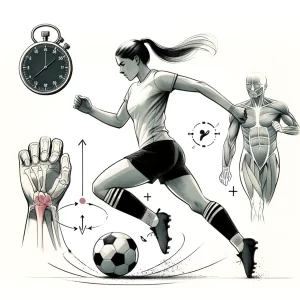
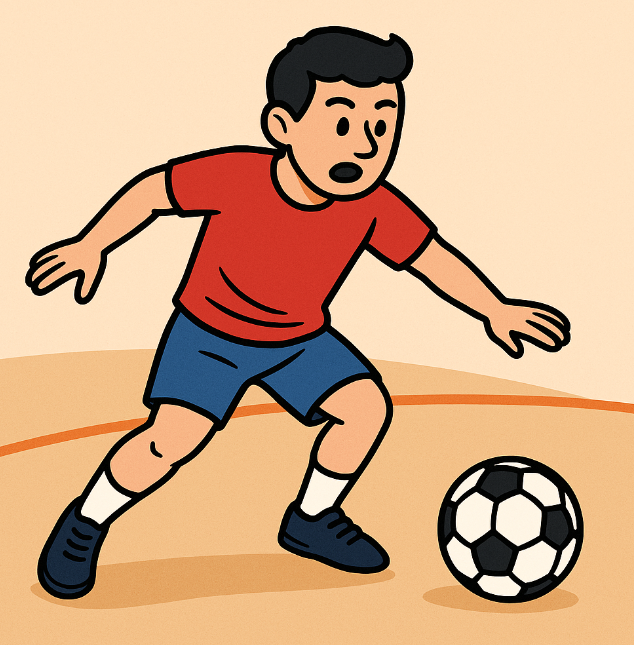
If you’ve ever watched a winger explode down the sideline and plant hard to send a defender the wrong way, you’ve seen one of the most dangerous moments in soccer: the sudden side-cut. Players make these cuts hundreds of times per match: at full speed, under pressure, often while fatigued. And every one of those cuts loads the knee with forces up to seven times bodyweight.
That’s why the ACL continues to be one of the most devastating injuries in soccer. But here’s the twist: most ACL tears happen without contact. They come from faulty movement patterns—especially dynamic knee valgus (the knee collapsing inward). A new study on futsal athletes shows we can significantly reduce this risk using simple programs that teams can build into warm-ups and practices today. s4
This matters not just for preventing injuries, but also for boosting confidence, achieving sharper cuts, and supporting long-term player development.
What the Research Found—and Why It Matters
The study followed 45 professional futsal players with dynamic knee valgus. Players were randomly assigned to one of three groups:
- Stop-X Program – balance, plyometrics, strength, landing technique
- Knee Control Program – neuromuscular + core stability training
- Control Group – regular training only
They trained for eight weeks, then were tested on high-speed side-cutting using force plates and motion-capture analysis.
The big takeaway: Both Stop-X and knee control training dramatically improved knee safety.
Players in both programs:
- Reduced dynamic knee valgus by 5–6 degrees
- Increased strength and control during cuts
- Improved balance and stability (measured through center-of-pressure changes)
- Showed kinetic patterns linked to lower ACL injury risk
Meanwhile, the control group—doing business as usual—showed virtually no improvement.
In simple terms, eight weeks of targeted exercises helped athletes maintain stronger, safer knee positions during the most dangerous movement in the sport.
Even more interesting: the two programs worked almost equally well. That means coaches can choose based on time, equipment, and player preference.
Breaking Down the Science in Soccer Language
Let’s translate this into something you’d see on the field.
Dynamic knee valgus
This is when the knee caves inward during landing or cutting. Think of a player planting and the knee drifting toward the other foot—that “collapse” loads the ACL and surrounding tissues.
Ground reaction force (GRF)
This is the force coming up from the ground into the player’s leg. Higher GRF isn’t necessarily bad—poor alignment with high GRF is what gets players hurt.
Center of pressure (COP)
This is how much a player wobbles or shifts during the cut. Less wobble = more stability = safer knees.
What the study showed:
The exercises didn’t just make players stronger. They improved coordination from the hip to the ankle, allowing players to absorb force more safely and efficiently. They cut harder, but with better control.
That’s a win for performance and injury prevention.
How Coaches Can Use This Tomorrow: 4 Actionable Tips
1. Add knee-control work to every warm-up
Even 10–12 minutes is enough. Try:
- Single-leg squats
- Lateral hops
- Hip raises
- Lunges with control emphasis
- Balance drills on firm or soft surfaces
2. Train the “whole chain,” not just the knee
The study makes it clear: valgus collapse starts at the hip and ankle. Add:
- Glute strengthening (clam shells, lateral band walks)
- Hamstring work (Nordics, bridges)
- Ankling and plyometric footwork drills
3. Coach controlled landings and cuts
Use cues players understand:
- “Knee over the laces”
- “Soft but strong landing”
- “Hips level”
- “Push the ground away, don’t sink”
Film one drill per week—players correct faster when they can see the movement.
4. Build these exercises into competitive play
Better knee alignment shouldn’t happen only in warm-ups. Try integrating:
- Controlled stop-and-cut races
- Reactive agility games
- Small-sided games that force repeated changes of direction
Players learn fastest when biomechanics meet game pressure.
Why This Fits the Bigger Picture
- Youth development: Teaching movement quality early reduces long-term injury burden.
- Player safety: With ACL injuries sidelining players for 9–12 months, low-cost prevention is one of the smartest investments a club can make.
- Performance analytics: The better an athlete controls valgus and GRF, the sharper their change of direction—an essential trait in modern high-tempo futsal and soccer.
- Club sustainability: Losing players to preventable injuries hurts performance, roster depth, and development cycles.
This isn’t extra work—it’s better work.
Your Turn to Kick It Off
The science is clear: small, consistent doses of knee-control training can dramatically reduce injury risk while improving cutting performance. You don’t need a lab. You just need intention and five to ten minutes a session.
So here’s what to think about:
- Which part of your practice this week could include knee-control work?
- What movements do your players struggle to control—landings, cuts, decelerations?
- How can you blend science-based training with competitive fun so players stay engaged?
Comment below or share your own knee-control tips—we’re building safer, stronger, smarter players together.