Why Futsal Makes Smarter, Fitter Players
A coach once told me, “You can spot a futsal kid in five seconds—they think faster.” He wasn’t wrong. Across youth academies worldwide—from Brazil to Spain to rising programs in the U.S.—futsal is becoming the secret weapon for sharper touches, quicker decisions, and smarter movement.
But why does it work? And what does the science say?
A massive systematic review of futsal research finally gives us the answers. The study pulled together findings from physiology, psychology, biomechanics, injury research, and coaching development to paint a powerful picture of futsal’s value for player development.
What emerges is clear: If you’re not using futsal to develop players, your club is leaving performance on the table.
The Research: What Makes Futsal Such a Powerhouse?
Futsal is not just “indoor soccer.” It’s a compressed, high-speed, decision-heavy environment that builds attributes traditional soccer struggles to teach: immediate decision-making, tight-space control, tactical intelligence, and elite-level conditioning.
The review examined 44 studies that looked at how futsal impacts participation, coaching, physiology, psychology, injuries, and tactics. Let’s break down what actually matters for coaches and clubs.
1. Futsal Builds Game-Ready Fitness Faster Than You Think
Futsal isn’t just a technical playground—it’s a physiological beast. Studies show:
- Elite futsal players have significantly higher aerobic fitness than lower-tier players, meaning the sport naturally selects for and develops endurance and repeat-sprint ability.
- Futsal demands players repeatedly push into 85–90% of maximum heart rate, even in controlled small-sided formats.
- Skill-based interval training in futsal improved VO₂max by nearly 10% in just a few weeks for women’s players.
Small changes also matter:
- Dropping from 4v4 to 2v2 dramatically increases intensity, dribbling actions, and ball touches.
- Shorter reps demand higher heart-rate zones, creating match-like stress every session.
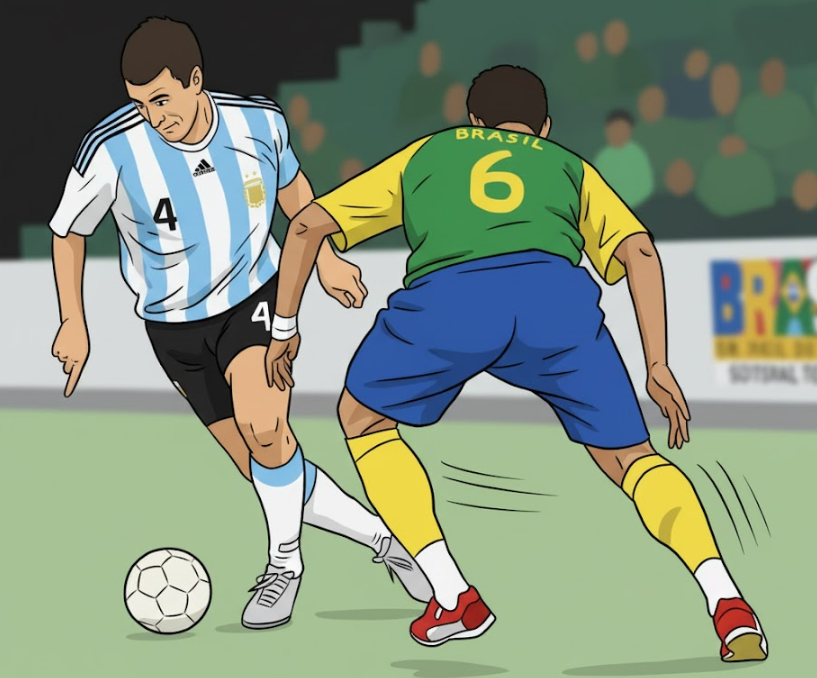
Why it matters for soccer: Soccer players often lag in repeat-sprint ability. Futsal forces constant acceleration, deceleration, and turning—exactly the physical actions that decide matches in the final third.
2. Futsal Creates Smarter, More Creative Decision-Makers
One of the most compelling findings from the review is that decision-making improves dramatically when drills force players to interpret more options. Two major takeaways emerged:
- Training centered on decision-making produces more intelligent, creative players: Coaches who used variable, game-realistic drills (uncertain passes, multiple options, changing defensive pressure) created players with better tactical understanding.
- Players adapt their passing based on interpersonal distance: Research using video tracking showed players fine-tune pass speed, direction, and timing when defenders close space—even a few feet. That means mental processing speeds up under pressure.
In simple terms: Futsal teaches players to scan, react, and adapt at lightning speed. For young soccer players, this translates to fewer turnovers, quicker combination play, and better off-ball movement.
3. Tactical Intelligence Skyrockets Through Repetition and Constraint
Modern soccer is obsessed with “small-sided games” (SSGs), and futsal is the original masterclass. The review found:
- Most elite futsal goals came from set plays and counterattacks, not open attack—highlighting the need to teach pattern recognition.
- Futsal players repeatedly operate in compressed spaces, learning how to create angles, move defenders, and manipulate gaps.
- Spatial awareness is dramatically sharper in futsal athletes—attackers naturally claim larger “dominant regions” (their functional area of space).
For coaches: If your team struggles breaking pressure, your players don’t have a spacing problem—they have a futsal problem.
4. Injuries in Futsal Are Manageable—If You Prepare Right
Injury risk is real, especially ankle sprains and lower-body strains. But the good news:
- Futsal has lower injury rates than outdoor soccer in several competitions.
- “The 11+” warm-up improved sprinting, agility, jumping, and balance while reducing fall risk.
- Most training injuries are minor (sprains/strains), while competition injuries involve contact.
If you run futsal sessions, don’t skip a structured warm-up. It’s not just injury prevention—it’s athletic development.
5. Coaching Quality Matters More Than Anything Else
One of the most surprising insights? Coaches with more futsal-specific education create dramatically different training sessions.
Elite and intermediate coaches:
- Used more small-sided games
- Created more “inferiority” scenarios (3v2, 2v3)
- Focused on timing, decision-making, and cognitive load
Novice coaches:
- Relied on isolated technical drills
- Offered fewer game-realistic challenges
- Developed players who were less adaptable under pressure
If a club uses futsal without futsal coaching education, they’re leaving most of the benefits unused.
Actionable Training Takeaways for Coaches
1. Use 2v2 and 3v3 to build intensity and decision-making
- More touches
- More pressure
- More game-realistic stress
Perfect for conditioning + tactical development.
2. Treat futsal video analysis as a teaching tool
Players who watched film improved significantly in ball control, dribbling, and finishing.
3. Prioritize decision-based drills—not isolated technique
Use rondos, pressure boxes, transition gates, and variable passing patterns.
4. Make “The 11+” your standard warm-up
Builds sprint speed, balance, power, and reduces injury risk.
5. Use futsal as a youth development pipeline
Younger players especially benefit from:
- Smaller ball
- More touches
- Faster play
- More situational repetitions
This is how you develop intelligent midfielders and press-resistant defenders.
Your Turn to Kick It Off
How will you use futsal in your next training session?
What small-sided format pushes your players the most?
Should more clubs adopt futsal as a core piece of player development?
Drop your thoughts, experiences, or training questions below—let’s build smarter players together.