Why Small-Sided Games Work
Picture this: it’s the last 20 minutes of training. Players are tired, touches get sloppy, and you’re deciding whether to run fitness laps or play one more game. You choose a 4v4. Suddenly, intensity spikes. Players talk more. Decisions come faster. Heart rates climb. Everyone is locked in.
That instinct—to choose the game over the laps—is backed by a huge body of science.
A major systematic review of 77 high-quality studies confirms what many great coaches already feel in their bones: small-sided games in soccer are among the most powerful tools we have for training fitness, technique, tactics, and decision-making simultaneously. Small-sided games in soccer are not just for pros—but for youth players, amateurs, and developing clubs.
Let’s break down what the research really says, and how you can use it tomorrow.
What the Research Looked At
The review analyzed decades of research on small-sided games (SSGs)—games played with fewer players, smaller pitches, and modified rules. Researchers didn’t just ask if SSGs work. They asked:
- How does pitch size change intensity and spacing?
- What happens when you adjust player numbers (2v2 vs. 5v5)?
- Do rules (touch limits, scoring zones, floaters) matter?
- How does coach encouragement affect effort?
- Do SSGs train fitness as well as traditional running?
The answer, over and over: yes—but only if you design them with intention. Think of SSGs like a mixing board. Every knob you turn—space, numbers, rules—changes what players learn.
Why Small-Sided Games Are So Effective
Here’s the big takeaway: SSGs replicate the chaos of real matches. Instead of isolated drills, players are constantly:
- Scanning for space
- Solving pressure
- Coordinating with teammates
- Switching from attack to defense
The review shows that SSGs:
- Raise heart rates into match-like zones
- Increase high-intensity actions and accelerations
- Improve technical involvement (more touches, passes, shots)
- Develop tactical awareness through repeated real decisions
In short: you train the body, brain, and ball together Small sided games in soccer a….
5 Actionable Training Insights You Can Use Now
1. Smaller Games = Higher Intensity
2v2 and 3v3 games consistently produce higher heart rates and more intense actions than larger formats. They’re ideal for conditioning with the ball.
Try this: Use 2v2 or 3v3 for short bursts (2–4 minutes) when you want explosive effort and competitiveness.
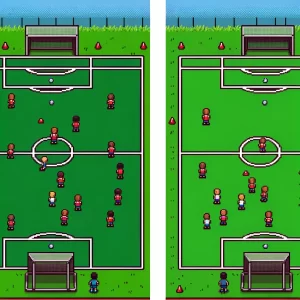
2. Space Per Player Matters More Than Total Field Size
It’s not just “big field vs small field.” What matters is space per player. More space encourages sprinting and long runs. Less space forces quick decisions and tight control.
Try this:
- Tight space → pressing, combination play
- Larger space → counterattacks, recovery runs
3. Rules Shape Behavior Instantly
Touch limits, scoring zones, or neutral players dramatically change how teams play. Want quicker ball movement? Limit touches. Want width? Add wide scoring zones.
Try this: Change one rule at a time so players clearly feel the difference.
4. Coach Energy Drives Player Effort
Studies found that active coach encouragement increases intensity during SSGs. Silence leads to drop-offs.
Try this: Coach like it’s match day during fitness-focused SSGs. Save quiet observation for tactical sessions.
5. SSGs Beat Running for Engagement (and Often Fitness)
SSGs match or exceed traditional running drills for aerobic load—and players enjoy them more.
Try this: Replace one conditioning run per week with a high-intensity SSG block. Track effort, not laps.
How This Fits Bigger Soccer Trends
Modern soccer is faster, more tactical, and more data-informed than ever. This research supports major trends:
- Player safety: Load can be managed more precisely than random running.
- Youth development: SSGs mirror street soccer—decision-rich and creative.
- Coaching innovation: Training becomes adaptable instead of one-size-fits-all.
- Club identity: Clear SSG design reflects how you want your team to play.
Top academies and professional clubs already build entire sessions around SSGs. This research explains why it works—and how to do it better.
Internal & External Reading Suggestions
- Internal: “How Constraint-Based Coaching Builds Smarter Players”
- External: FIFA Training Centre – Game-Based Training Resources
Your Turn to Kick It Off
Small-sided games aren’t just filler or fun—they’re precision tools. When designed well, they train the exact behaviors matches demand. So now the question shifts from “Should we use SSGs?” to:
- How are you manipulating space, numbers, and rules in your sessions?
- Which age group or team could benefit most from tighter or looser constraints?
- What’s one traditional drill you could replace with a smarter small-sided game?
Drop your thoughts, adaptations, or favorite SSG formats below. Let’s keep learning—together.