The Psychology of Penalty Shootouts
Penalty shootouts are among the most intense moments in soccer. Entire tournaments—and sometimes national pride—can hinge on a single kick. But are shootouts just random luck, or are there predictable patterns behind who scores and who misses?
A recent study analyzing 1,186 penalty kicks across 122 shootouts in major tournaments (World Cup, European Championship, Copa América, and UEFA Champions League) offers new insights into how pressure affects performance. The findings reveal several patterns that coaches and players can use to design smarter penalty strategies and training routines.
Below, we break down the research and translate it into practical lessons for soccer coaching, team strategy, and player preparation.
Why Penalty Shootouts Create Unique Pressure
Penalty shootouts are psychologically different from regular penalties during play. In shootouts:
- The outcome is highly visible and decisive
- Players have more time to think
- The entire team depends on the individual kicker
Sports psychology calls this performance pressure—situations where the importance of success increases anxiety and disrupts normal automatic skills. When pressure rises, players may:
- Overthink mechanics that are normally automatic
- Focus on crowd reactions or consequences
- Rush their routine
This phenomenon is commonly known as “choking under pressure.”
Key Findings from the Study
1. Tournament Level Affects Success Rates
Penalty conversion rates varied by tournament. For example, penalties in the World Cup were scored less often than in the European Championship or Copa América. Likely reasons include:
- Higher stakes
- Larger global audiences
- Greater perceived importance
Coaching takeaway
Players must train specifically for high-pressure scenarios, not just technical shooting. Practicing penalties at the end of a normal training session is not enough.
2. Late Shootout Rounds Are Harder
The study found that later kicks in the shootout tend to have lower success rates. Why? Because pressure builds as the shootout unfolds. Later kicks often include:
- Must-score situations
- Potential match-ending attempts
- Increased crowd tension
Coaching takeaway
Teams should prepare players mentally for:
- Round 4–5 kicks
- Sudden-death rounds
These are psychologically different situations than the opening kick.
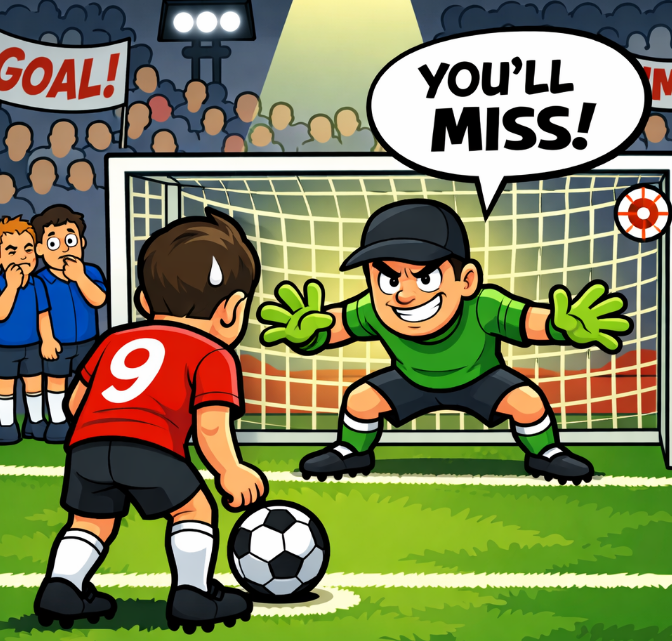
3. “Negative Pressure” Kicks Are the Most Difficult
One of the strongest findings involved kick valence. Researchers classified kicks as:
- Positive valence: scoring wins the match
- Neutral: outcome not immediately decisive
- Negative valence: missing immediately loses
Results:
- Positive valence kicks were far more successful
- Negative valence kicks had the lowest success rates
In other words, players perform worse when the focus is on avoiding failure rather than achieving success. This aligns with sports psychology research showing that avoidance motivation increases anxiety and rushed behavior.
Coaching takeaway
Players must be trained to reframe pressure situations. Instead of thinking, “I can’t miss,” they should think, “I’m scoring this.” Language matters.
4. Superstar Status Doesn’t Predict Success
Interestingly, the study found no reliable evidence that famous or award-winning players perform worse or better in shootouts. Earlier research suggested that superstars might choke more due to expectations. But with a larger dataset, this effect disappeared.
Coaching takeaway
Don’t assume:
- The biggest star should always take the decisive penalty
- Experienced players automatically handle pressure better
Instead, coaches should evaluate:
- Psychological readiness
- Confidence
- recent penalty practice performance
Strategic Lessons for Coaches
Here are several evidence-based strategies teams can adopt.
1. Simulate Real Shootout Pressure in Training
The study recommends scenario-based training that mimics the stress of real-world shootouts. Create practice scenarios like:
- “If you miss, your team loses”
- Sudden-death rounds
- Crowd noise played over speakers
- Teammates watching from midfield
The goal is to train both the mind and the technique.
2. Carefully Choose the Shooting Order
Research suggests player selection during shootouts often follows patterns:
- Strong attackers tend to shoot early
- Experienced players often take rounds 1 or 5
But coaches should also consider:
- Psychological resilience
- Routine consistency
- Comfort with pressure
Some players thrive in spotlight moments. Others perform best earlier in the order.
3. Train Players to Control Their Routine
Many missed penalties occur because players rush.
Under pressure, players may:
- shorten their run-up
- skip their normal breathing routine
- speed up decision-making
Coaches should encourage:
- consistent pre-kick rituals
- controlled breathing
- visual focus on the target
Routines anchor performance under stress.
4. Don’t Ignore the Goalkeeper Factor
While this study focused on shooters, other research shows goalkeepers can influence outcomes through:
- delayed movement
- deception
- distraction techniques
Some studies estimate goalkeeper strategies can improve save rates by 8–10%. That means: Shootouts are not only about the kicker. They are also about psychological games between kicker and goalkeeper.
Why Shootouts Are Still Hard to Predict
Even with all these insights, the model in the study explained only about 3–5% of the variation in outcomes. That means many other factors influence success:
- kicker skill
- goalkeeper strategy
- fatigue
- crowd noise
- team history in shootouts
In other words: Penalty shootouts remain unpredictable. But good preparation can tilt the odds.
What This Means for Youth and High School Coaches
These lessons aren’t just for the World Cup. They apply at every level. Coaches working with youth or high school players should:
- practice shootouts regularly
- simulate pressure situations
- help players build confidence routines
- rotate players through shootout roles
The biggest mistake? Treating penalties as just another shooting drill. They are a psychological challenge disguised as a technical skill.
Final Whistle
Penalty shootouts are not purely random. Research shows that pressure, context, and psychology influence success rates. For coaches, that means:
- train the mind
- simulate pressure
- plan the shootout order carefully
- prepare players for decisive moments
Because when the game reaches the penalty spot, the players who succeed are rarely the ones with the best technique alone.
They are the ones who can stay calm when the entire stadium is holding its breath.