Walking Football May Be More Than a Game for Dementia Caregivers
For many people, soccer is more than a sport. It is memory, movement, friendship, routine, and identity. A new qualitative study in Scientific Reports suggests that a slower, adapted version of the game, known as walking football, may offer something especially powerful for people living with dementia and the caregivers who support them.
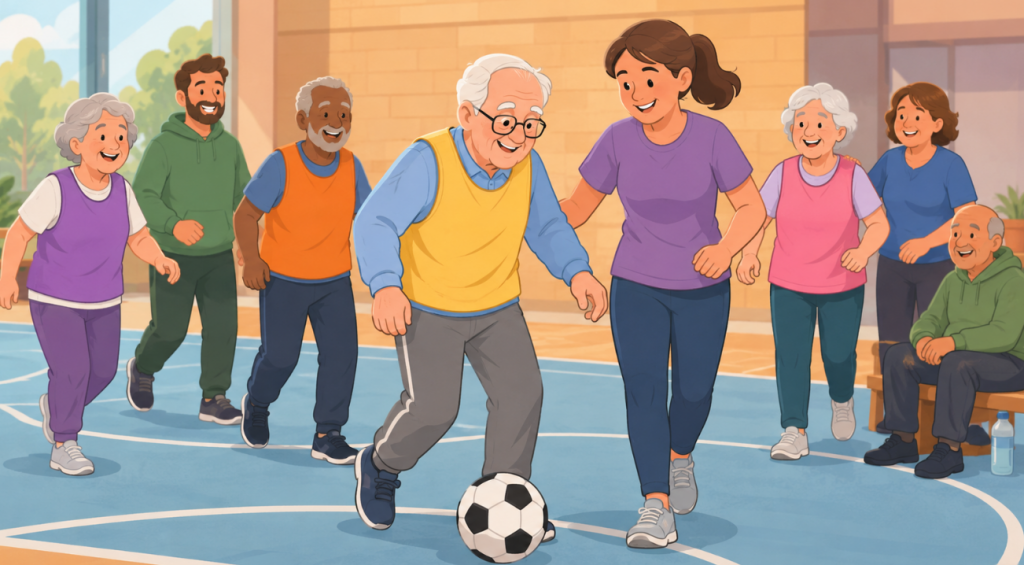
The study focused on caregivers of people living with dementia who took part in walking football sessions in the United Kingdom. Walking football is exactly what it sounds like: soccer played at a walking pace, with rules designed to reduce running, heavy contact, and injury risk. It was originally developed to help older adults stay active, but researchers are now exploring its potential as a community-based activity for people living with dementia.
What they found was not just a story about exercise. It was a story about relief, connection, joy, and the possibility that soccer can help caregivers and loved ones share something that feels normal again.
What Is Walking Football?
Walking football is a modified form of soccer designed to make the game more accessible for older adults and people who may not be able to participate in traditional soccer. Players walk instead of run, and the rules limit physical contact.
That makes it a lower-impact version of the sport, but not a passive one. Participants still move, pass, shoot, socialize, compete, and laugh. For people who grew up loving soccer, the ball itself can carry emotional meaning. It can bring back memories of who they were before illness, caregiving, or aging changed their daily lives.
In this study, walking football sessions lasted about an hour and were followed by time for refreshments and socializing. That structure mattered. The soccer was important, but so was the coffee afterward.
Why This Matters for Dementia Caregivers
Dementia does not affect only the person diagnosed. It also reshapes the lives of spouses, family members, friends, and volunteers who provide care. Caregivers often experience stress, guilt, isolation, and a shrinking sense of independence.
The study notes that caregivers can face restrictions on personal time, reduced social participation, and lower quality of life. Walking football appeared to address some of those pressures by creating a shared space where caregivers could connect with others, move their bodies, and briefly step outside the constant demands of the caregiving role.
That is a key point. This was not just “respite” in the traditional sense, where the caregiver leaves while someone else takes over. Instead, the researchers describe walking football as a kind of co-participatory respite. Caregivers and people living with dementia could be present together, but in a setting where the relationship was not defined only by care tasks.
For caregivers, that distinction may matter deeply. Instead of feeling like they were stepping away from their loved one, they were sharing an activity with them.
The Five Benefits Caregivers Described
The researchers identified five major themes related to caregivers’ experiences: caregiver burden, social interaction, emotional and mental wellbeing, physical engagement, and quality of life.
First, caregivers described the real strain of caring for someone with dementia. They talked about frustration, guilt, and the difficulty of finding meaningful activities. Walking football did not erase those challenges, but it gave caregivers something positive and structured to look forward to.
Second, the sessions created social connections. Caregivers could talk with people who understood their lives without needing to explain everything. That kind of informal peer support can be hard to find.
Third, walking football supported emotional wellbeing. Caregivers described the sessions as a break from the house, the routine, and the constant mental load of caregiving. The activity offered laughter, companionship, and a sense of normalcy.
Fourth, caregivers also benefited physically. Some joined in and found that the movement helped them feel more active. For caregivers who spend much of their time focused on someone else’s needs, that physical engagement may be an important reminder that their own health matters too.
Finally, participants described improvements in quality of life. Walking football gave both caregivers and their loved ones something to anticipate. In caregiving, that simple phrase — “something to look forward to” — can mean a lot.
Benefits for People Living With Dementia
The study also identified three themes related to people living with dementia: memory recollection, physical activity, and community belonging.
For some participants, soccer seemed to unlock memories and embodied skills. Caregivers and volunteers noticed that when people living with dementia were given a ball, they sometimes appeared to reconnect with earlier parts of themselves. The researchers described this as memory recollection, but it also points to something soccer fans know intuitively: the body remembers the game.
Walking football also helped people living with dementia stay physically active. Movement is important for health, but exercise programs often fail when they feel boring, clinical, or disconnected from people’s interests. A familiar sport may make activity more enjoyable and easier to sustain.
The third benefit was belonging. The sessions created a community routine where people could play, talk, drink tea or coffee, and be part of a group. For people living with dementia, that sense of inclusion can be just as important as the exercise itself.
Soccer as a Social Prescription
This study fits into a larger conversation about social prescribing, which means connecting people to community-based activities that support health and wellbeing. Walking football may be especially promising because it combines several ingredients at once: physical activity, social connection, routine, identity, and enjoyment.
That combination is important. Health programs often focus on one outcome at a time. Walking football seems to work differently. It is not just exercise. It is not just support group time. It is not just respite. It is a shared social activity built around a game many people already know and love.
For soccer clubs, community organizations, dementia support groups, and local health systems, this opens an interesting possibility. Walking football could be a relatively low-cost, community-based way to support both people living with dementia and their caregivers.
What the Study Cannot Tell Us Yet
The findings are promising, but they should be interpreted carefully. This was a small qualitative study with six participants from a single walking football program in the UK. The goal was depth, not broad generalization.
That means we should not claim that walking football will work the same way for every caregiver, every person living with dementia, or every community. More research is needed with larger and more diverse groups, including studies that compare walking football with other activities and follow participants over time.
Still, small qualitative studies can do something valuable: they show us what an intervention feels like in real life. In this case, the study suggests that walking football may help caregivers and people living with dementia experience movement, memory, and community together.
The Bigger Soccer Story
Soccer is often discussed in terms of performance, tactics, trophies, and elite athletes. But this study reminds us that the game has another kind of power.
A ball, a few teammates, a safe place to play, and a cup of coffee afterward can become more than recreation. For caregivers, walking football may offer relief from isolation. For people living with dementia, it may support memory, movement, and belonging. For communities, it may be a practical way to make soccer more inclusive across age, ability, and health status.
The lesson is simple: soccer does not have to be fast to be meaningful. Sometimes, slowing the game down may help more people stay in it.